A sponsor calls in week three of a recruitment campaign because nothing is spending. The media plan was approved, the budget is sitting there, and every ad in the account is either still in review or already rejected. This happens constantly, and it is almost never the budget or the targeting. It is the copy, the landing page, and the way the account is set up to handle health-related advertising.
We run recruitment campaigns for clinical trials across Google, Microsoft Ads, Meta, Instagram, Reddit, LinkedIn and geofenced in-app display. Every one of those platforms treats health advertising as a restricted category, and every one of them draws the line in a slightly different place. A headline that runs fine on Reddit will get an entire Meta ad account flagged.
Below is what actually gets flagged, with real examples from campaigns we have run. Client names, URLs and logos are redacted because trial sponsors have their own disclosure rules, but the creative is otherwise exactly as it ran.
The rule every platform shares: you cannot imply the person is sick
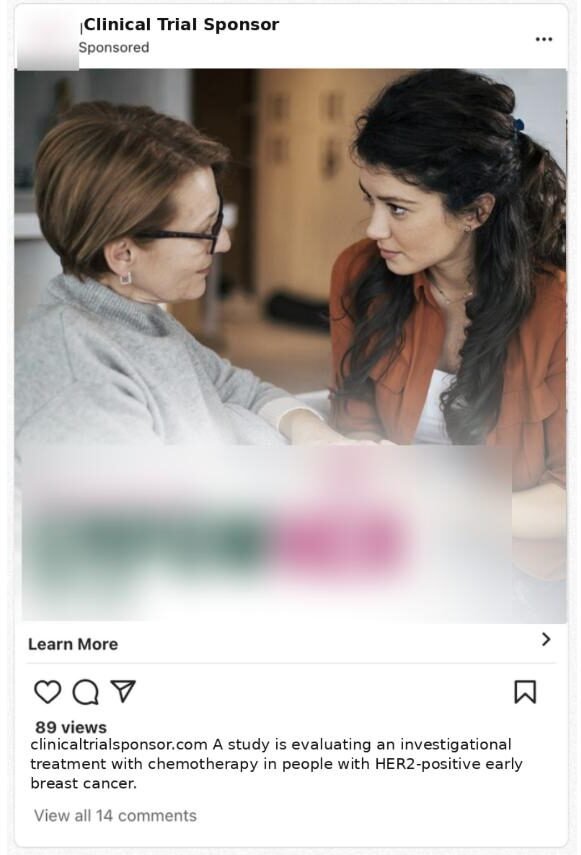
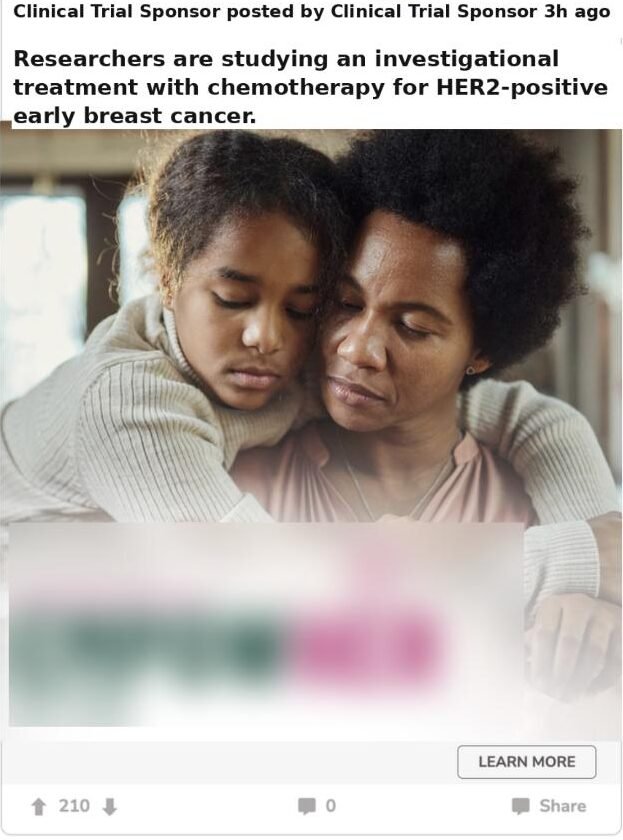
This is the single biggest cause of rejections, and it catches people who have never advertised in health before. Personalized health advertising rules across Google and Meta prohibit implying knowledge of a person’s medical condition. “Struggling with your depression?” targets the reader. “Researchers are studying an investigational treatment for depression” describes the study.
It sounds like a small edit. It is the difference between a campaign that spends and a campaign that gets an account-level warning.
Search ads: the landing page gets reviewed too
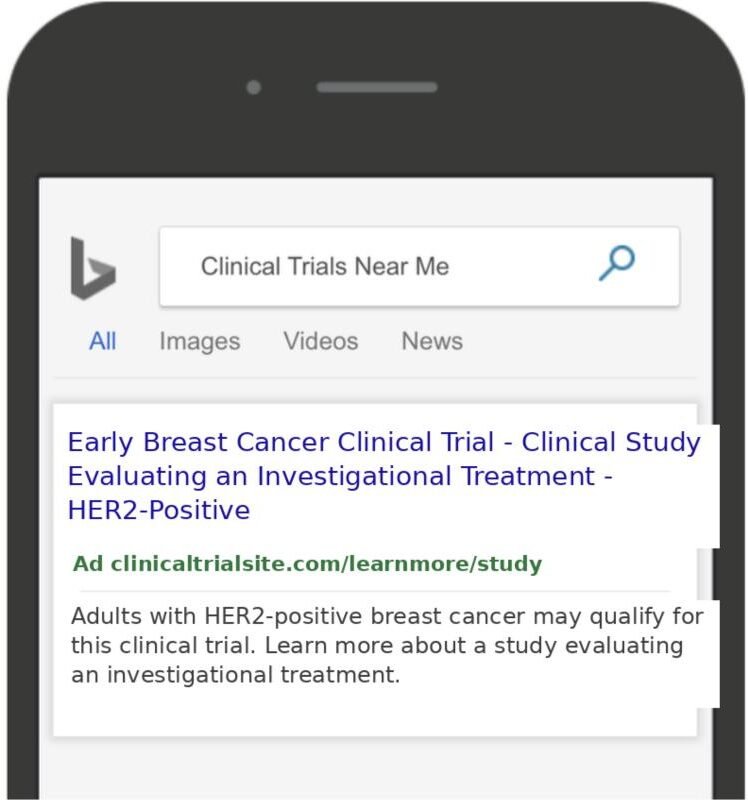
People assume a disapproval is about the ad. On Google and Microsoft Ads, the destination page is part of the review. If the ad says “investigational treatment” and the landing page says “new treatment that works,” the ad gets pulled and the page is what caused it.
For trial recruitment we keep four things consistent between the ad and the page: the word “investigational,” the absence of any efficacy claim, a visible statement that this is a research study, and the eligibility criteria in plain language above the form.
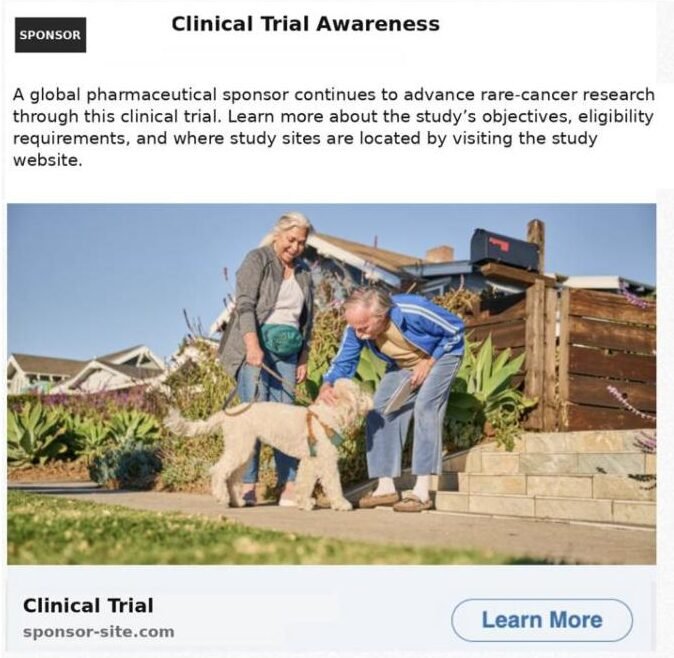
Patient recruitment and physician referral are two campaigns, not one campaign with two audiences. Trying to run them as one is how you end up with copy that satisfies neither reviewer.
Geofencing: the placement is the compliance risk
Geofenced display around treatment centers, hospitals and conference venues works well for trial recruitment and for campaigns aimed at healthcare professionals. It is also where health advertising rules get strictest, because fencing a specific clinic can be read as targeting people by condition.
We keep geofences wide enough to cover a district rather than a single building entrance, and we keep the creative purely informational. No condition in the headline, no urgency language, a plain “Now enrolling” and a link to the study page.

What actually gets flagged
After enough of these, the rejection reasons repeat. This is the pre-flight list we run every trial creative through before anything is submitted:
- Second-person condition language. “Your diagnosis,” “if you have,” “suffering from.” Rewrite to describe the study.
- Any implied benefit. “Effective,” “proven,” “relief,” “improvement.” The treatment is investigational until it is not.
- Compensation in the headline. Payment for participation can usually be mentioned, but leading with it reads as an inducement and gets rejected across most platforms.
- Before and after imagery, or distressed-patient stock photos. Both read as targeting by condition.
- A landing page that contradicts the ad. They are reviewed together, so they have to say the same thing.
- Missing study identifiers. Sponsor, protocol reference and a route to the full study information belong on the page, not buried.
- Health data flowing into the ad platform. Covered below, and the one that causes real damage rather than a rejection.
The tracking problem nobody catches until it is live
Getting the ads approved is half of it. The other half is measuring recruitment without sending health information to an ad platform, which is where healthcare advertisers get into genuine trouble rather than just getting a disapproval.
Standard pixel setups happily pass page URLs, form field values and query strings back to Meta and Google. On a trial site, a URL like /study/her2-positive/screening-complete is health information about an identifiable person the moment it is paired with a browser ID. That is a problem for the sponsor long before it is a problem for the campaign.
The setup we use: server-side events through the Conversions API with a clean event name and no condition in the payload, URL parameters stripped before anything fires, form fields never passed as event parameters, and screening outcomes matched back offline instead of in the browser. The campaign still optimizes, and nothing diagnostic leaves the site.
A lead-routing fix that had nothing to do with creative
A client’s Meta instant-form leads were never reaching their CRM, and duplicate pixel events were inflating reported lead counts several times over. The team was optimizing against numbers that were not real, and following up on leads that had never been routed to anyone.
We remapped the instant-form fields to the correct CRM fields, rebuilt the lead trigger and the internal notification webhook, and removed the duplicate events. The result was one clean lead record per submission, routed and notified automatically, and a cost per lead that finally meant what it said.
Organic still carries recruitment, especially for site-level trials
Paid gets the volume, but for trials tied to a specific clinic, the practice’s own search visibility does a surprising amount of the enrollment work. People who see a trial ad go and search the clinic’s name before they fill anything in, and what they find decides whether they convert.
That is worth protecting, and it is measurable. Two of our healthcare clients currently hold top positions for their core service terms, ahead of much larger competitors, which means the credibility check after the ad click lands on their own site rather than a competitor’s.
Two healthcare practices outranking much larger competitors
Chicago IV Solution holds the #1 organic position for “ketamine therapy chicago,” a competitive metro term contested by national mental-health chains.
Dallas Sleep Health holds #2 for “sleep center dallas tx,” ranking above two hospital systems and a university medical center for their core term.
What to do before your next trial campaign launches
- Write the landing page first, get it through MLR, then write ads that match its language exactly.
- Split patient recruitment and physician referral into separate campaigns with separate creative.
- Run every asset through the flag list above before submission, not after a rejection.
- Audit the tracking setup for anything diagnostic in URLs, event names or form parameters.
- Build in two weeks of review time. Restricted-category review is slower, and appeals are slower still.
None of this makes recruitment easy. It does make it predictable, which for a sponsor watching an enrollment curve is most of what they want. If you want a second set of eyes on a campaign that is not clearing review, our digital advertising and analytics services cover exactly this work, and you can see more of our healthcare and clinical trial campaigns in the portfolio.
Frequently asked questions
Can you advertise a clinical trial on Meta and Instagram at all?
Yes. Trial recruitment runs on Meta regularly. The constraint is that the creative cannot imply knowledge of the viewer’s health condition, and the targeting cannot be built from health-related interests. Campaigns are typically built on geography, age and broad behavioral signals instead, with the creative doing the qualifying.
Why did my trial ad get approved and then disapproved later?
Almost always a landing page change. Platforms re-review destinations periodically, so a page edit made after launch, even one made by another team, can pull previously approved ads. Lock the page and route edits through whoever owns the campaign.
Can we mention participant compensation?
Usually yes, but not as the lead message. Compensation stated as a secondary detail on the landing page is generally acceptable. Compensation as the headline reads as an inducement to participate and gets rejected across most platforms.
How do we measure recruitment without violating HIPAA?
Keep condition-specific information out of anything that reaches an ad platform. That means server-side conversion events with generic names, URL parameters stripped before tracking fires, form field values never passed as event parameters, and screening outcomes reconciled offline rather than in the browser.
How long does approval take for a restricted health category?
Plan for one to two weeks across platforms, longer where certification is required before a health advertiser can run at all. Appeals add time, which is the argument for pre-flighting creative rather than learning from rejections.
Running a trial that is not enrolling fast enough?
We build recruitment campaigns that clear compliance review the first time, across search, social and geofenced display.


