There’s a quiet shift happening on Google.
Not loud. Not dramatic. But persistent.
Search something simple—“best time to post on Instagram,” maybe—and the answer just… appears. Right there. No need to click. No need to explore. It’s convenient. Almost too convenient.
And somewhere, a website that worked hard to rank for that query doesn’t get the visit it expected.
This is where zero-click searches SEO begins to feel less like a concept and more like a reality you can’t ignore.
What Zero-Click Searches Really Mean (Beyond the Definition)
At a surface level, it’s easy to explain: users search, Google answers, and no click happens.
But underneath that… something more interesting is unfolding.
Search behavior is becoming impatient. People aren’t browsing the way they used to. They want clarity, quickly. A sentence. Maybe two. Enough to move on.
Google noticed. And adapted.
So now you have:
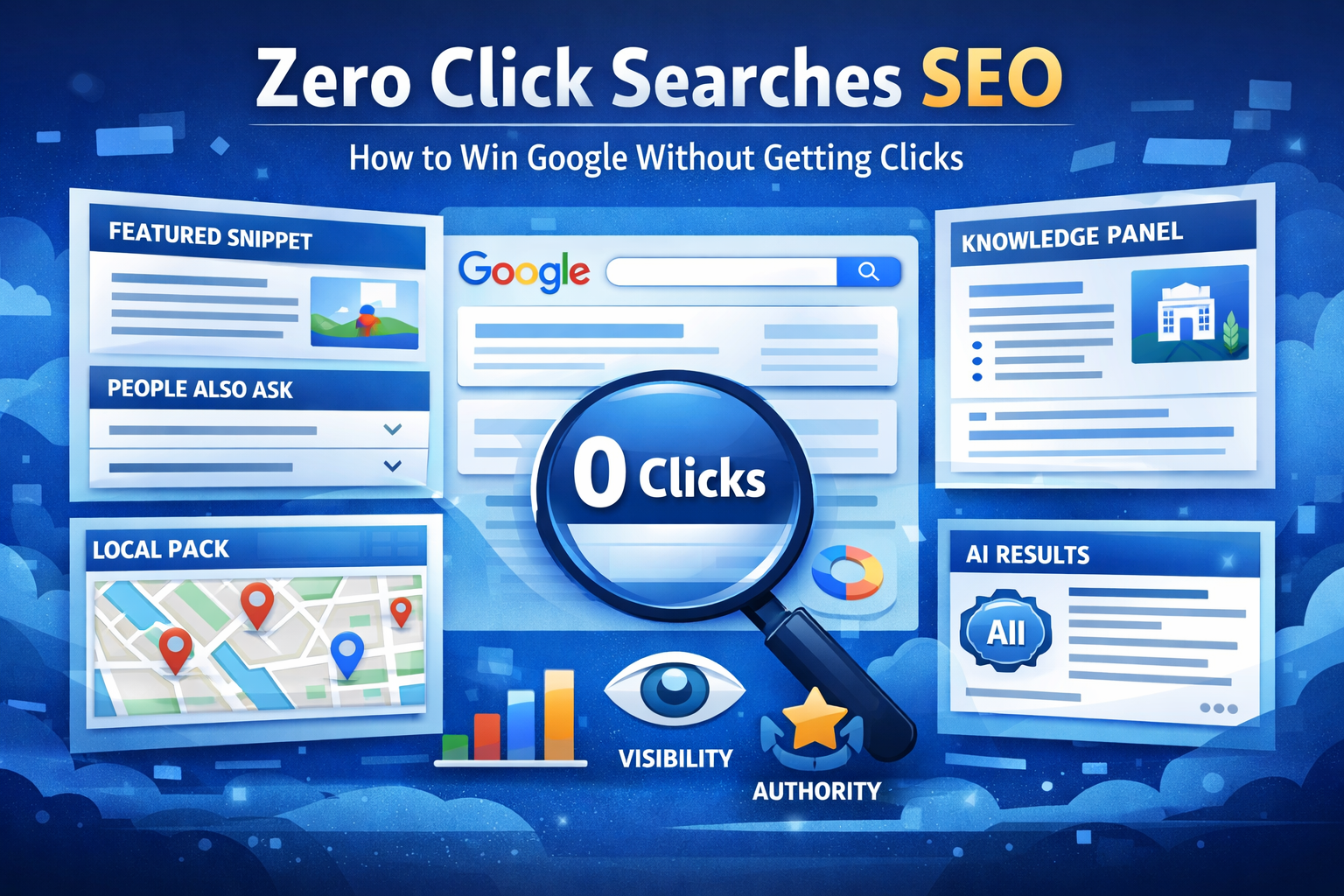
- Featured snippets sit above everything else
- “People Also Ask” boxes are expanding endlessly
- AI-generated summaries stitching together multiple sources
- Knowledge panels that feel almost… final
It’s not just about ranking anymore. It’s about being chosen as the answer.
And that’s a different game.
Why This Isn’t as Bad as It First Feels
There’s usually a moment—especially for businesses tracking traffic—where zero-click searches feel like a loss.
Fewer clicks. Lower sessions. A dip in numbers that used to feel stable.
But here’s the quieter truth.
Visibility hasn’t disappeared. It’s just… changed shape.
Being featured in a snippet or an answer box does something subtle:
It places a brand in front of the user before they even consider alternatives.
Not everyone clicks. But many remember.
And memory, oddly enough, converts later.
Where These “No-Click” Moments Actually Happen
Some patterns show up again and again.
A user asks a question—something specific, slightly conversational. Google responds with a boxed answer. Clean. Structured. Done.
That’s the featured snippet.
Then there are those expandable questions—People Also Ask. One click leads to another, then another. A rabbit hole without leaving the page.
And sometimes, especially with branded or informational searches, a knowledge panel quietly takes over the right side. Authority, summarized.
For local businesses, it’s even more immediate. Maps. Reviews. Contact details. Decisions happen right there.
Clicks? Optional.
How Content Needs to Shift (Gently, Not Drastically)
There’s a temptation to overcorrect here. To rewrite everything. To chase snippets aggressively.
That usually backfires.
What tends to work instead is a softer adjustment.
Content that answers questions early. Not buried halfway down the page. Not wrapped in unnecessary buildup.
A heading that mirrors a real query.
A short, direct response beneath it.
Then, if needed, depth.
Almost like layering—quick clarity first, deeper insight after.
Google seems to prefer that rhythm. And, truthfully, so do people.
The Subtle Art of Being “Snippet-Worthy”
It’s rarely about tricks.
No hidden formula. No guaranteed structure.
But there are patterns.
Clear definitions.
Concise explanations—often around a few sentences, not paragraphs.
Occasional lists, when the topic naturally calls for them.
A tone that feels certain, but not mechanical.
And perhaps most importantly, content that actually resolves the question it promises to answer.
There’s something else, too—something less technical.
Content that feels trustworthy. Not overly optimized. Not trying too hard.
Just… helpful.
The Role of Topical Depth (Even When No One Clicks)
This part is easy to overlook.
If users aren’t always visiting the page, why invest in deeper content?
Because Google still reads everything.
It connects pages. Understands themes. Builds a sense of authority over time.
A site that explores a topic from multiple angles—naturally, without forcing it—starts to feel reliable in the algorithm’s eyes.
This is where approaches like topical authority SEO quietly support zero-click visibility. Even if the user only sees a snippet, that snippet is backed by something much larger.
Something consistent.
AI Is Accelerating This… Quietly
Search results are becoming more interpretive.
Less about matching keywords, more about understanding intent.
AI summaries—those blended answers pulling from different sources—are becoming more common. And they rarely visibly credit just one page.
It can feel frustrating. Content being used without a clear reward.
But the pattern remains:
Sources that are structured well, clear in thought, and consistent in topic tend to appear more often in these summaries.
Not always visibly. But often enough to matter.
So… Where Do Clicks Fit In Now?
They’re still there. Just… more selective.
Users click when they want depth. When the surface answer isn’t enough. When curiosity extends beyond convenience.
And that means the role of content shifts slightly.
From “getting the click” to “earning the next step.”
A snippet introduces.
The page deepens.
The brand lingers.
It’s less linear than before. But no less valuable.
A Small Misstep Many Still Make
There’s a tendency to chase traffic numbers as the only signal of success.
Refresh dashboards. Watch impressions rise, clicks fall. Try to fix it quickly.
But not all visibility translates immediately.
Some of it sits quietly in the background—building recognition, familiarity, even trust.
And those things… they show up later. In branded searches. In direct visits. In conversions that don’t trace neatly back to a single click.
It’s messier than traditional SEO. But also, in some ways, more human.
Letting Go of the Old Definition of “Winning”
For a long time, search success meant one thing: ranking first and getting the click.
Now, it’s broader.
Sometimes winning looks like being the answer, even if the user never visits.
Sometimes it appears repeatedly across different queries, until the name feels familiar.
And sometimes… It’s simply being present in the moment a decision starts forming.
Zero-click searches aren’t the end of SEO.
They’re just a reminder that attention doesn’t always behave the way metrics expect it to.
And maybe that’s not entirely a bad thing.
A Simple Next Step
For businesses trying to make sense of all this—how visibility, structure, and search behavior now intertwine—there’s value in stepping back and looking at the bigger picture.
A structured audit can help uncover where opportunities exist, especially in areas like snippets, content clarity, and search intent alignment.
Explore that process here:
👉stardigitalmarketing.org/contact-us/
And for a broader look at how search is evolving, this overview from Google offers useful context:
👉Developers.google.com/search/docs/fundamentals/seo-starter-guide
Sometimes, understanding the shift is half the work. The rest follows more naturally than expected.